Sablemark Advisory Group LLC
Fix Credit • Get Funding • Build Leverage
Whether you're preparing for a mortgage or rebuilding after setbacks, we work with you to fix your credit and move forward with confidence.

Built for Strategy. Ready for Escalation.
Every file we take on is built with care, precision, and a long-term strategy in mind. We document each step and track all timelines, so if your case ever needs to be escalated to arbitration or federal litigation, it's ready. That includes violations, communications, and supporting evidence-all organized and on file.You won't have to start from scratch if things get serious. You'll always be prepared
01
Full Credit Review
We begin with a detailed analysis of your credit reports from all three major bureaus. Our team reviews every account, inquiry, and remark to identify information that is inaccurate, outdated, or cannot be verified. This step is critical. It forms the foundation for everything that follows.
02
Custom Dispute Strategy
Once we've identified the issues, we handcraft personalized dispute letters tailored to your situation. These are not templates. They're communications sent to the CRAs (Credit Reporting Agencies) Experian, Equifax, and TransUnion and/or the original creditors or furnishers. Each letter challenges specific inaccuracies and demands correction or deletion under the law.

03
Legal Escalation (If Needed)
In some cases, especially when timelines are tight or violations are ongoing, we may escalate your file to arbitration or federal litigation. This is always based on your goals and preferences. It is not required for every client.
If the CRAs or furnishers fail to respond appropriately to our disputes, we may recommend pushing for legal action to demand deletion, correction, or even pursue compensation if your rights under the FCRA or FDCPA have been violated.
04
Moving Forward
Once your credit file is stable, we connect you with the right people to help you move forward. Whether that's a mortgage broker, loan officer, investor, or private lender. If your goal is funding, we help you access $25,000-$100,000 in new credit through our partner network. You're never left wondering what comes next. We guide you to the next opportunity.

Your Results Start with One Step
Want to improve your credit, too? Let's take the first step together.
Understanding Your Credit Report
A Clear Guide to Common Credit Report Entries
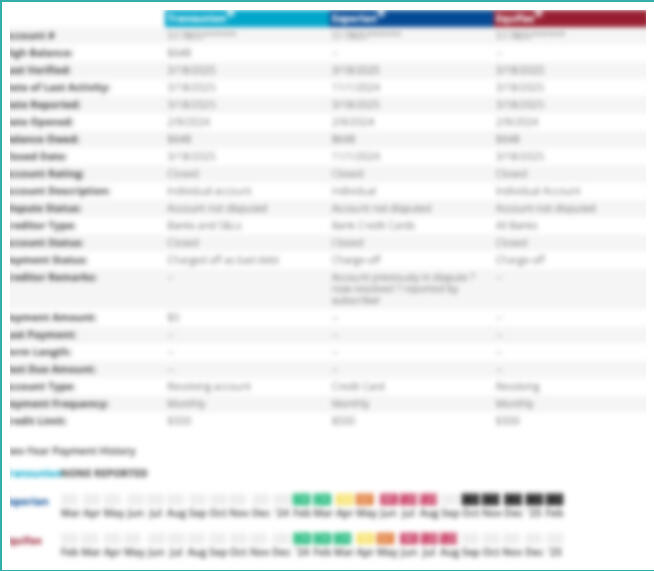
Your credit report is a snapshot of your financial history. Lenders use it to decide whether to approve loans, set interest rates, or offer credit. Below is a breakdown of the most common entries you might see on a credit report and what they actually mean.
Charge-Offs
When a debt goes unpaid for a long time (usually 120-180 days), the original lender may close the account and mark it as a financial loss on their books. Even though the account is closed, it often gets transferred to a collection agency.
Collections
Collections occur when a lender sends or sells an unpaid debt to a collection agency. The agency then attempts to recover the money. Collections can appear for things like credit cards, medical bills, or utility accounts that went unpaid.
Repossessions
Repossessions happen when a borrower fails to make payments on a loan secured by an item (most likely a car). The lender takes back (repossesses) the item due to missed payments. Repossession records reflect that the borrower defaulted on the agreement.
Student Loans
These loans are used to pay for college tuition, books, and living expenses. They typically offer lower interest rates and deferred repayment while the student is enrolled in school. Student loans can be federal or private and often have different rules and benefits.
Bankruptcies
Bankruptcy is a legal process that allows individuals or businesses to restructure or eliminate certain debts when they're unable to repay them. The two most common types are Chapter 7 (liquidation) and Chapter 13 (repayment plan). Bankruptcy is a public legal record and shows up on credit reports as a serious event.
Judgments
A judgment is a legal decision made by a court when someone loses a lawsuit and is ordered to pay a certain amount of money. This can happen in debt-related cases when a lender or collector sues for unpaid amounts. Judgments may appear on the credit report as a public record.
Foreclosures
Foreclosure is the legal process a mortgage lender uses to take back property when the borrower stops making payments. The lender sells the home to recover the loan balance. A foreclosure typically means the borrower was unable to keep up with the mortgage agreement.
Credit Inquiries
Credit inquiries appear when someone checks your credit report. There are two types:
• Soft Inquiries: Routine checks, such as when you view your own credit or a lender pre-approves you for an offer. These do not affect your credit score.
• Hard Inquiries: Happen when you apply for credit, like a loan or credit card. These can have a small, temporary impact on your score.
Child Support
If court-ordered child support is not paid, it may be reported as a delinquent account. These entries usually come from government agencies and reflect unpaid obligations related to child support enforcement actions.
Have Questions? Let's Talk.
If your credit report is a mess, say so.
If a creditor is playing games, name them.
If you're just trying to understand what you're looking at, that's fine too.
© 2026 Sablemark Advisory Group LLC. All rights reserved.